
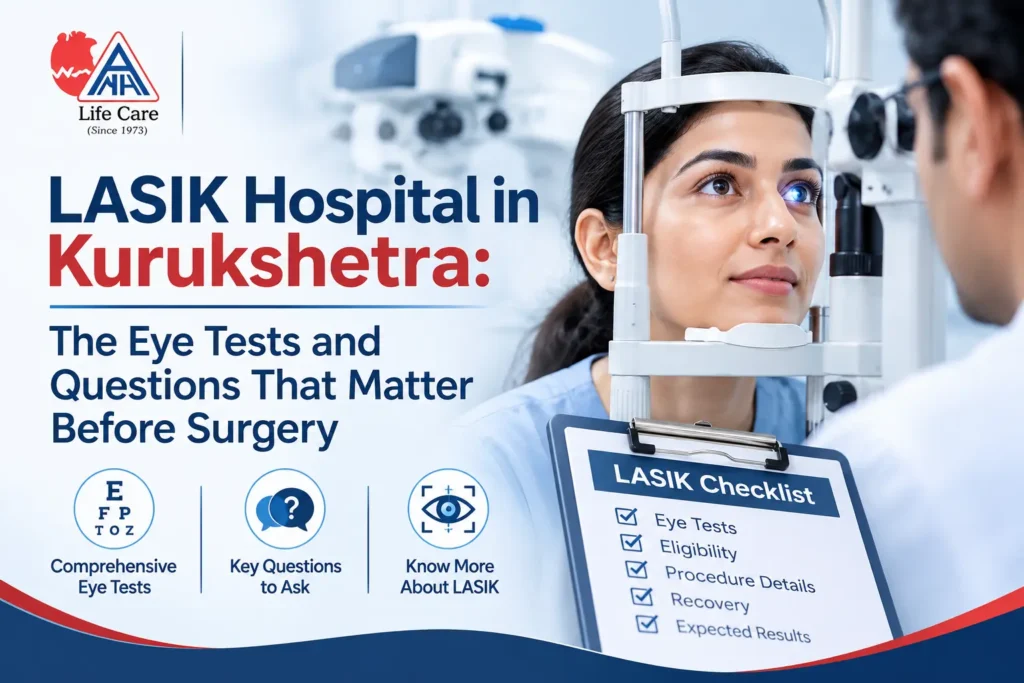
If you are searching for a LASIK hospital in Kurukshetra, understanding the consultation process can help you ask informed questions, avoid unrealistic expectations and make a decision based on your eye health rather than advertising.
LASIK, short for laser-assisted in situ keratomileusis, changes the shape of the cornea so that light focuses more accurately on the retina. For appropriately selected adults with short-sightedness, long-sightedness or astigmatism, it can reduce the need for glasses or contact lenses. But the same spectacle number can mean different things in two different eyes. Corneal shape, corneal thickness, dry-eye symptoms and prescription stability often matter as much as the power written on a prescription.
This guide focuses on what happens before treatment: how to prepare, which investigations are relevant, the reasons a surgeon may advise postponement or an alternative, and what to clarify before giving consent. It is intended for people in Kurukshetra and surrounding Haryana communities considering a LASIK evaluation, not as a substitute for a personal clinical examination.
Why a LASIK consultation is more than a spectacle-power check
An ordinary spectacle test estimates the lens correction needed for clearer vision. A refractive surgery assessment asks a different question: can the eye be safely reshaped while preserving its structural strength and visual quality? A clear answer requires measurements, clinical history and a discussion of trade-offs. Good unaided vision the day after a procedure is only one possible outcome measure. Comfort, night vision, long-term corneal health and expectations about reading glasses also matter.
An ophthalmologist may recommend LASIK, suggest treating an eye-surface condition first, request repeat measurements, discuss another refractive procedure, or advise remaining with glasses or contact lenses. A recommendation not to operate can be an appropriate outcome of a careful assessment.
Before your appointment: five details to bring
Your old and current prescriptions
Bring available spectacle prescriptions from the last one to two years. The clinician can compare them with the current refraction to assess whether the power has remained sufficiently stable. A prescription that is still changing can lead to a disappointing result even if the initial measurements appear promising. Patients in their late teens and early twenties may need particular attention to stability. Age alone does not establish eligibility.
A complete contact-lens history
Tell the clinic whether you wear soft, toric, rigid gas-permeable or other contact lenses, and how often you wear them. Contact lenses can temporarily alter the corneal surface and affect measurements. The period during which you must avoid lenses varies by lens type and individual findings; your eye-care team should give a specific plan before the baseline tests. Do not guess a universal number of days from social media.
Agarwal Nursing Home | Patient Education | November 2026
A list of medicines and medical conditions
Mention diabetes, autoimmune conditions, previous eye injuries or surgery, recurring eye infections, allergies, and medicines that could affect healing or tear production. Pregnancy or breastfeeding may be associated with temporary changes in refraction, making elective surgery timing worth discussing. A medical condition is not automatically a yes-or-no answer; it changes what the clinician needs to evaluate.
Your daily visual demands
Explain what you actually want to do without glasses. A person who drives at night has different concerns from someone who works mainly at a computer. Sports, dusty environments, long screen hours and close-up work are relevant to treatment planning. Tell the surgeon whether you already use reading glasses or struggle with near vision. LASIK does not prevent age-related presbyopia.
Your questions and expected recovery window
Bring a short list of questions about risks, time off work, the likely need for drops, postoperative visits and costs. Arrange transport on surgery day if treatment goes ahead. You should not plan to drive yourself immediately after the procedure. The most useful consultation is one where you can understand the choices and leave with a written plan.
Seven assessments that may guide LASIK suitability
Refraction and visual acuity
The examination measures vision with and without corrective lenses and checks the spectacle power. The surgeon considers whether your refractive error falls within a treatable range and whether it has been stable. In some cases a dilated or cycloplegic refraction is appropriate, especially when accommodation may influence the reading.
Corneal topography or tomography
Corneal mapping evaluates the shape and curvature of the front of the eye. Tomography can provide information about the anterior and posterior corneal surfaces and thickness distribution. These tests are important for detecting suspicious patterns, including signs that might suggest keratoconus or another form of corneal weakness. A normal-looking eye in the mirror can still have an irregular corneal map.
Corneal thickness
Pachymetry measures corneal thickness. LASIK removes some corneal tissue to correct the prescription, so the team must assess how much tissue would be altered and whether enough suitable tissue remains after treatment. A single thickness number without considering curvature, planned correction and overall risk factors is not sufficient to decide eligibility.
Tear film and ocular-surface examination
Dry eyes can cause intermittent blur, gritty sensations and poor contact-lens tolerance. LASIK can worsen dryness, sometimes for an extended period. The clinician may inspect the eyelids, evaluate the tear film and check the ocular surface. Treating significant dryness or eyelid inflammation before considering surgery can improve the accuracy of testing and the quality of postoperative comfort.
Agarwal Nursing Home | Patient Education | November 2026
Pupil and night-vision considerations
Some patients experience glare, halos or starbursts after LASIK, particularly in dim lighting. Night-driving needs and existing visual symptoms should be discussed before treatment. Pupil measurements may be considered as part of the evaluation, although pupil size alone cannot predict the final quality of night vision.
Eye pressure and general eye-health examination
A complete eye review helps identify conditions that could change treatment planning. For example, glaucoma, inflammation, cataract or other disorders can affect whether elective corneal surgery is appropriate. The doctor may check eye pressure and examine the lens, optic nerve and other structures as clinically indicated. The purpose is to assess the whole eye, not simply the spectacle prescription.
Retinal evaluation when indicated
People with high myopia can have retinal changes that merit careful assessment. A dilated retinal examination may be appropriate before surgery, particularly when symptoms or clinical findings raise concern. Sudden flashes, numerous new floaters or a curtain-like shadow in vision need urgent eye assessment rather than routine LASIK booking. Corneal laser treatment does not remove underlying retinal risk associated with high myopia.
When the result is “not yet” or “not suitable”
Some people expect a LASIK consultation to end with a fixed surgery date. In reality, further testing or a delay may be the safest recommendation. Common reasons include changing spectacle power, untreated dry eye, abnormal corneal mapping, inadequate corneal tissue for the planned correction, or an active eye condition. Severe or uncontrolled systemic disease can also affect the decision. A surgeon should explain the specific concern rather than give a vague rejection.
If you have been advised against LASIK, ask whether the concern is temporary or structural. Temporary issues may need treatment and repeat testing. Structural corneal concerns may make certain laser procedures inappropriate even if the spectacle power is modest. No alternative procedure is automatically safe; every option has its own eligibility criteria and risks.
LASIK, other refractive procedures and glasses: understanding the decision
For a general discussion of LASIK and the hospital’s refractive-care approach, read the verified LASIK service page: https://agarwalhospitals.com/lasik/.
For a previously published explanation comparing LASIK with implantable contact lenses, see: https://agarwalhospitals.com/lasik-vs-icl-which-vision-correction-procedure-is-right-for-you/.
Both are background reading; neither replaces a personalized recommendation.
What the LASIK procedure generally involves
If the assessment supports LASIK, the clinic will explain preparation and obtain informed consent. Numbing eye drops are commonly used. During treatment, the surgeon creates a thin corneal flap, applies an excimer laser to reshape the tissue, and repositions the flap. Patients may notice pressure, changing vision, lights or unusual sounds. Exact steps, duration and recovery vary with the individual and treatment system. Ask what you should expect at that particular facility rather than relying on an online video.
Some blurring, watering, light sensitivity or scratchiness may occur after surgery. Many patients improve quickly, but healing and visual stabilization are individual processes. Follow-up visits and prescribed medication are essential. A small number of patients have persistent symptoms or complications, and additional correction may not be possible or advisable. Perfect vision without glasses is never guaranteed.
How to understand the risks before consenting
A balanced discussion should cover both likely benefits and meaningful downsides. Dry eye, fluctuating vision, glare, halos and nighttime visual disturbances can occur. Less common but serious problems include infection, flap-related issues, corneal ectasia and loss of best-corrected vision. Undercorrection or overcorrection can leave a need for spectacles. Some people still need reading glasses as they age even when distance vision improves. Ask how the team evaluates risks in your particular eyes, what symptoms to report and how complications would be managed.
Risk discussion should use understandable language. Terms such as ectasia, higher-order aberrations and residual correction may sound technical, but you are entitled to a plain-English explanation. Ectasia refers to progressive weakening and shape change of the cornea; careful preoperative screening aims to reduce, not eliminate, that risk. Higher-order aberrations can affect the quality of vision even when a standard eye-chart reading looks satisfactory.
Questions worth asking a LASIK hospital in Kurukshetra
What did my corneal maps show, and were any measurements borderline?
Has my spectacle power been stable long enough for elective treatment?
Do I have dry eye, and should it be treated before surgery?
What are the expected benefits and main risks for my specific eyes?
Could I still require distance or reading glasses afterward?
Which reasonable alternatives should I consider, including no surgery?
What is included in the quoted fee and follow-up plan?
Which symptoms after surgery require an urgent telephone call or visit?
These questions make it easier to compare a consultation meaningfully. Price, promotional language and promises about how quickly someone can stop wearing glasses cannot replace individual risk assessment. A good decision should still feel right after you have understood the potential limitations.
After LASIK: the first days and follow-up
Your treating team should give specific written instructions. Common precautions include not rubbing the eyes, using prescribed drops exactly as directed, protecting the eyes from irritants, and attending early postoperative reviews. Swimming, eye makeup, contact sports and strenuous activities may need to be avoided for a period determined by the surgeon. Do not restart old eye drops or change prescribed medication without medical advice.
Agarwal Nursing Home | Patient Education | November 2026
Mild early discomfort or temporary blur may be expected, but severe pain, significant deterioration in vision, increasing redness or symptoms that worsen rather than improve need prompt contact with the treating doctor. Do not wait for a scheduled appointment if an urgent warning sign develops. Follow-up is not optional simply because you can read clearly without spectacles.
How your profession and lifestyle can affect planning
A desk-based professional may be concerned about screen comfort and dryness; frequent screen breaks and ocular-surface care may matter during recovery. A night-shift driver should discuss glare and low-light vision before surgery, not afterward. A sportsperson may need to ask about flap-related trauma risks and the timetable for returning to contact activities. A student whose prescription is still changing may benefit from waiting. The goal is not to match every person to LASIK but to match the decision to clinical findings and realistic routines.
People travelling from Thanesar, Shahabad, Pehowa or nearby areas should factor in the initial evaluation and subsequent follow-up visits. Some patients require more than one preoperative appointment if measurements need repeating. Ask about the likely visit schedule before making travel or leave arrangements, especially when returning to work quickly is important.
LASIK evaluation at Agarwal Nursing Home, Kurukshetra
Agarwal Nursing Home lists LASIK and refractive surgery within its eye-care services. Its official doctor profile identifies Dr. Aman Agarwal as an MBBS, MS (Ophthalmology) Consultant Ophthalmologist, with refractive surgery and LASIK laser treatment among his areas of work. This article does not assume that any particular branded LASIK technology or additional refractive procedure is available; patients should confirm the recommended treatment directly with the hospital.
Hospital eye services: https://agarwalhospitals.com/eye-services/.
Doctor information: https://agarwalhospitals.com/dr-aman-agarwal/.
For broader context about the hospital’s ophthalmology services, see https://agarwalhospitals.com/eye-care-in-kurukshetra-cataract-lasik-retina-care-2026/.
If you are comparing a LASIK hospital in Kurukshetra, an appropriate starting point is a comprehensive consultation focused on prescription stability, corneal health, tear-film status, general eye health and realistic expectations. The decision to proceed should follow examination and informed consent, not a search ranking or a generic claim about outcomes.
Frequently Asked Questions About LASIK Evaluation in Kurukshetra
1. Can I book LASIK surgery on the same day as my first consultation?
It is better to expect an assessment first. The doctor may need stable measurements, contact-lens discontinuation or treatment of an eye-surface problem before confirming a surgery date.
2. Can two people with the same spectacle power receive different advice?
Yes. Corneal shape, thickness, dryness, age, medical history and visual requirements can differ significantly even when the prescription is identical.
Agarwal Nursing Home | Patient Education | November 2026
3. Why must I stop contact lenses before LASIK testing?
Contact lenses can temporarily change corneal curvature. Your clinic will advise how long to leave them out based on the lens type and the stability of your measurements.
4. Does having thin corneas always mean LASIK is impossible?
Not necessarily, but corneal thickness must be interpreted with the planned correction, corneal mapping and other risk factors. Your ophthalmologist must make the decision.
5. Can LASIK be considered if I have dry eyes?
Dry eye requires careful assessment because LASIK can worsen symptoms. Your surgeon may recommend treatment and reevaluation or a different approach, depending on severity and other findings.
6. Is LASIK suitable if my glasses number changed recently?
A changing prescription can make outcomes less predictable. The surgeon typically looks for sufficient refractive stability and may advise waiting.
7. Will LASIK also prevent reading glasses after age 40?
No. LASIK does not stop presbyopia, the age-related reduction in near focusing ability. Your consultation should address future reading-glass needs.
8. Is night driving always normal immediately after LASIK?
No. Vision may fluctuate during healing, and glare or halos can affect night driving. Resume driving only when your doctor confirms it is appropriate and you meet legal visual requirements.
9. What warning signs after LASIK need urgent review?
Severe pain, worsening vision, marked redness or new concerning symptoms warrant immediate contact with the treating team. Do not wait for a routine follow-up.
10. Where can I arrange a LASIK evaluation in Kurukshetra?
Agarwal Nursing Home lists LASIK services at Salarpur Road, Kurukshetra, Haryana 136118. Call 82228 11455 to ask about consultations, required tests and appointment availability.
Contact and appointment information
Agarwal Nursing Home | Salarpur Road, Kurukshetra, Haryana 136118 | Phone: 82228 11455 | Website: https://agarwalhospitals.com/.
Contact the hospital to confirm appointment slots, consultation requirements, procedure availability and charges. An examination is required before determining individual suitability.
Conclusion: Choose an informed assessment before choosing surgery
The most valuable result of a LASIK consultation is clarity about your options. For some people, the findings support refractive surgery; for others, they point toward treatment of dry eye, further monitoring or staying with spectacles. When looking for a LASIK hospital in Kurukshetra, ask about corneal mapping, prescription stability, realistic outcomes and a structured follow-up plan. An informed decision should protect eye health while respecting your lifestyle and visual goals.